Showing posts with label Actually. Show all posts

Tuesday, February 14, 2017

Conversion Rate Optimization: How to Actually Convert the Traffic on Your Site?

pexels-photo-94654Everyone has heard the saying that ‘content is king’. Unfortunately there’s often a disconnect between creating incredible content on a blog or landing page and then converting the traffic you get from it. Webpages must be properly designed and presented in order to consistently convert online consumers. This design will depend on a thorough understanding of buyer personas, competitor websites, value propositions and website analytics. Any website redesign should rely on solid data from legitimate sources like Google Analytics.

Succinctly Present Unique Value Propositions

According to Forbes, when online visitors arrive on the homepage or landing page, they should immediately understand the value of purchasing the products or services. For example, the Internet is swarming with similar email service providers that all offer business customers unique advantages. The best option is to present a call-to-action that is directed at a specific demographic. This means that an email service provider should state that their email service is extremely user-friendly with free email marketing and campaign templates available.

Any small business owner, who will most likely have to do everything by themselves with limited computer training, will immediately appreciate the non- technical simplicity of the offer. On the other hand, calls-to-action for connecting through social media or newsletters should justify the effort by offering exclusive benefits. It may help to use clearly written advantages in bullet points with references to proven facts or research.

Leverage Psychology Principles

Business owners should apply basic concepts of psychology to their web page’s design, formatting and presentation. For example, cognitive psychology reveals that people typically organize their knowledge and experiences in symmetrical patterns. This means that people naturally prefer clarity over complexity because complicated things may lead to potential problems.

A webpage that is crowded with walls of text will turn off online consumers. When consumers are presented with a long product return policy, they are more likely to choose a business with a simple return policy that guarantees no headaches or holdups. In addition to this, a company’s homepage may display multiple calls-to-action, such as signing up, browsing the store, reading news updates or receiving free gifts. A high number of calls-to-action will actually result in indecisiveness.

Refine Calls-to-Actions

A company that simply posts what they feel are incentivizing calls-to-action may be disappointed when online consumers fail to respond. Effective calls-to-action need a short and effective headline paired with an informative infographic to help guide visitors. For example, instead of encouraging online visitors to try a new downloadable product, the call-to-action should state a request, such as “download now,” and clarify the cost, which should be “free.” Keep in mind that some people are visual learners respond stronger to pictures and videos, while other visitors may speak another primary language.

Many websites feel that their lengthy production selection process helps consumers to find the right item, but it also wastes time for who those in a rush or know what they want. Major retailers, such as Amazon and Wal-Mart, feature search engines that result in hundreds of unrelated items. Therefore, offer alternative product selection search engines for the most popular items.

Online Consumer Research

Mapping buyer personas, who are specific groups of potential customers, will help to establish the archetypal consumer for marketing purposes. Optimizing websites based on buyer personas shifts the focus from profits and products to consumers’ needs and wants. People care about themselves and finding answers to their problems, so website designs should be optimized accordingly. Establishing buyer personas will explain decision making processes and clarity how they arrive at final conclusions. Buyer personas can be created through web analytics and interviews with customers. For example, a Lawn Doctor’s lawn care services page will need separate subpages for both residential and commercial clients.

As a final note, it’s important to understand how website visitors’ past experiences contribute to their interpretations of current interactions. To illustrate, many calls-to-action for purchasing an item display a shopping cart button or a button with says “add to cart.” Both of these must be used together because the shopping cart icon has only recently emerged, so many consumers will be used to reading text.

The post Conversion Rate Optimization: How to Actually Convert the Traffic on Your Site? appeared first on Blogtrepreneur — For Busy Entrepreneurs.

Blogtrepreneur – For Busy Entrepreneurs

Conversion Rate Optimization: How to Actually Convert the Traffic on Your Site?
Wednesday, January 18, 2017

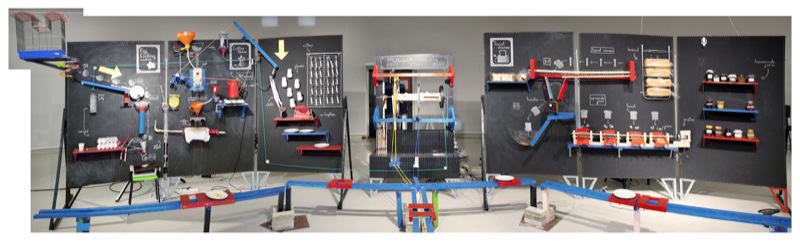
Your Marketing Funnel is Actually a Rube Goldberg Device

The traditional marketing funnel is gone, folks.

It’s been replaced by a gigantic, unpredictable, over-the-top Rube Goldberg device.

Giant rube goldberg device Foto: Johannes Abeling


There was a time when the “marketing funnel” was as simple as a consumer seeing a television ad, driving to the store, looking for your branded product, and then purchasing it.

Now, the consumer of that same product can receive a suggestion from his Amazon Echo, then decide to go read some reviews online, get sidetracked by a related (native advertising) article on the product, ask a few questions of the live chatbot on the product ordering page, decide to wait until Christmas, then go into a physical store to make the purchase.

This critical shift in the consumer mindset is going to require a similar shift in the marketing mindset.

5 Key Mindset Shifts to Deal with the New Marketing Funnel Reality

First of all, it’s not linear – the original funnel concept assumed that the customer went through a defined, linear process that was highly predictable. With the new, complex customer journey, there are sidetracks, cul de sacs, and fast-forwards. Each facet of your marketing approach needs to be able to stand alone, to account for consumers who jump into the middle of your marketing/sales process.

Second, you don’t know what they know – studies have claimed that up to 70% of the pre-purchase research is done before the customer even approaches a salesperson. In the new mindset, you can’t just launch into a canned pitch. You need to do a lot of questioning and listening, to find out what the person already knows or assumes about your product. This is so important to start building trust with your customer.

Third, agility is key – your marketing content arsenal needs to be diverse and refreshed frequently. You absolutely must be willing to experiment, pivot, and A/B test like a mad scientist. Schedule time to look at your analytics on a regular basis to see where your customers are coming from, where they’re going on your website, and which content is resonating (or not). Don’t forget to ask your prospects about their journey when you speak to them as well. “Oh, I decided to visit your site after an agency friend of mine recommended you at a conference I just attended.”

Fourth, spread your wings – the old funnel had a single output. You could stand there and take in the leads. Now, you need to put yourself out there and be ready to catch the ball wherever it emerges from the Rube Goldberg device. The new customer might reach out via a Tweet, a Facebook comment, an email, or by filling out your online inquiry form. It’s imperative that you have someone available to “answer the phone,” whatever that means to your customer.

Oh, and fifth, sales is different now too – HBR described this piece of the sales shift in an excellent article. The old sales playbook has been tossed out along with the marketing funnel.

How are you dealing with the new marketing funnel reality?


Author’s Bio: Rosemary O’Neill is an insightful spirit who works for Social Strata — makers of the Hoop.la community platform. Check out the Social Strata blog. You can find Rosemary on Google+ and on Twitter as @rhogroupee

Featured image via Flickr CC: Arne Hendriks

The post Your Marketing Funnel is Actually a Rube Goldberg Device appeared first on Successful Blog.

WuQV?d=yIl2AUoC8zA WuQV?i=4hsZY4P-Pno:VV_hcpo91O4:D7DqB2pKE WuQV?i=4hsZY4P-Pno:VV_hcpo91O4:F7zBnMyn0 WuQV?i=4hsZY4P-Pno:VV_hcpo91O4:V_sGLiPBp WuQV?i=4hsZY4P-Pno:VV_hcpo91O4:gIN9vFwOq


Successful Blog

Your Marketing Funnel is Actually a Rube Goldberg Device